Agent permissions
How Cyberdroid AI Investigation agents get their permissions.
What an investigation agent reads
An investigation may need more evidence, but that need does not grant access. Policy defines the permitted sources and recipients; software enforces those limits separately from model reasoning.
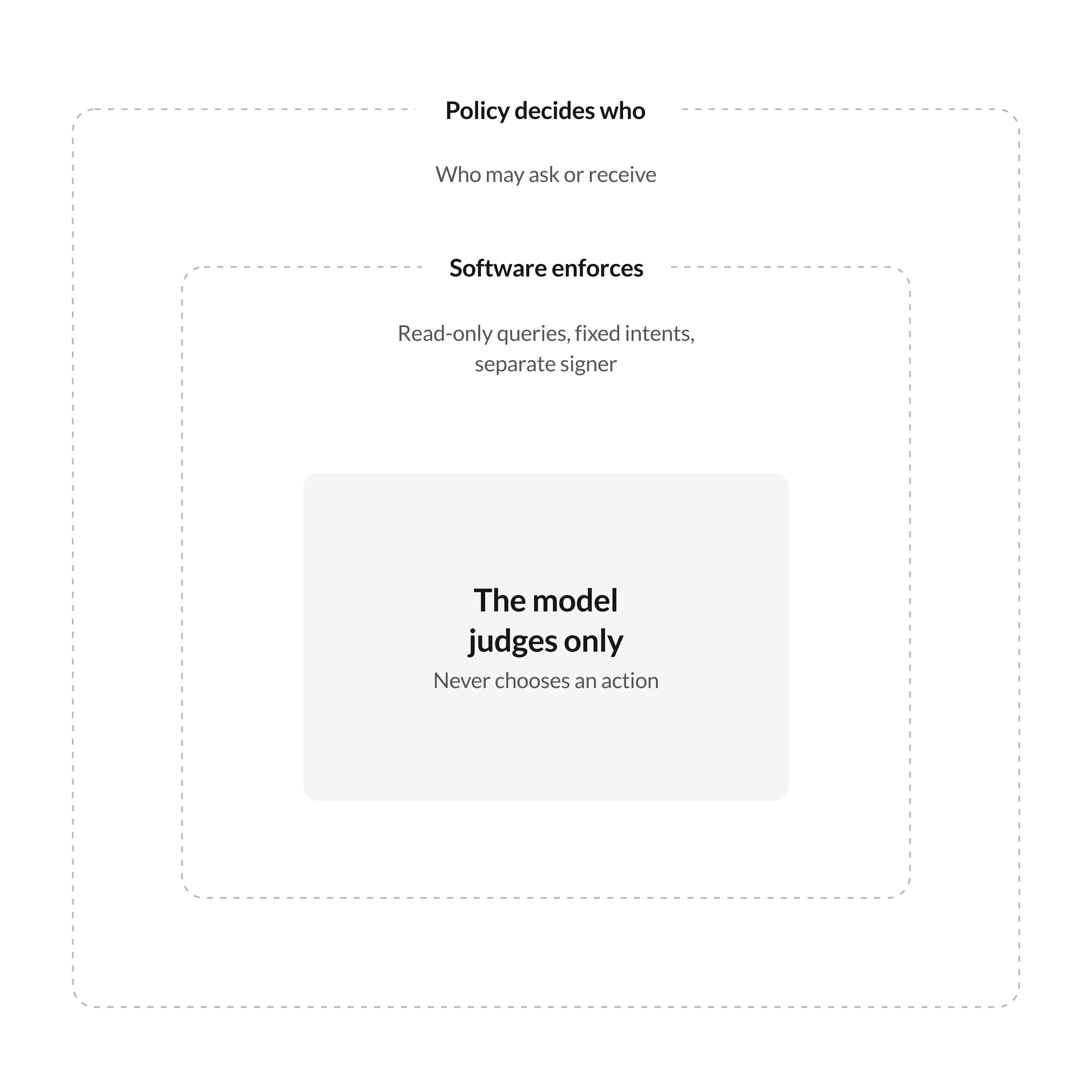
How access is configured
-
Who can ask
The policy sets who can ask, and about what.
-
Query building
Software turns the model’s questions into bounded, read-only queries on permitted sources.
-
One key per agent
Separate credentials make each agent’s access attributable and independently revocable.
-
Recipient checks
Recipients are checked before a reply is written and again after.
-
Reply approval
A separate authorization check governs release of a result, so the content of an answer cannot authorize its own delivery.
-
Model keys
Model-service access and routing are controlled separately from the agent’s data permissions.
Limits
Status
Cyberdroid AI Investigation is in early access.
Policy
Permissions depend on the configured policy. Review changes against the intended work and test the resulting access.
Records
Every grant and refusal is on record.
Outcomes
The record identifies what was requested, the outcome and the reason, including a refusal or a need for approval.
Keys
Each key can be rotated or revoked separately.
Standards
Naming a clause is not a claim of certification.
OWASP
OWASP lists Excessive Agency (LLM06:2025) and, for AI agents, identity and privilege abuse (2026). Policy-based access, generated queries and per-agent keys address both.
EU
Article 15 of the EU AI Act asks that high-risk systems resist unauthorized attempts to alter their use.
