Approach to safety
How ARRTECH builds, tests and reviews its AI.
What Cyberdroid does
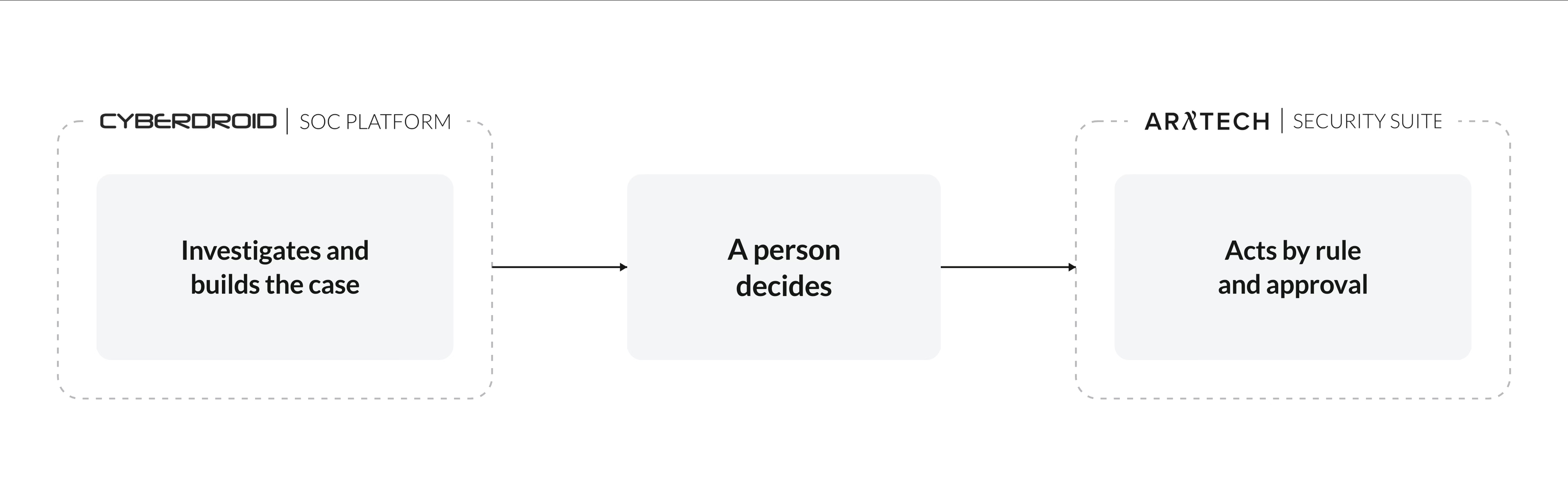
Cyberdroid learns normal behavior for each user, host and application, connects events across systems and investigates what changes. It writes each case with its evidence, verdict and next steps, and the analyst reviews and accepts it.
How it works
-
Visible evidence
A reviewer needs the observed activity, supporting records and context behind a finding. Missing evidence should remain visible.
-
Investigation and reporting
AI Investigation prepares an assessment for review. Response follows separately authorized policies and playbooks, with the relevant approvals recorded.
-
Who can ask questions
Policy sets which teams can ask AI Investigation questions and see its answers.
-
Local models
Both run on the organization's hardware with local models. An outside model fallback is optional.
-
Staged detector rollout
Each AI Detection detector is tested on the organization's data before it goes live. Promotions and rollbacks are recorded.
Limits
Timing
AI Detection analyzes each hour after it closes, so findings are near-hourly.
Availability
Cyberdroid AI Detection is available now to select organizations. Investigation, in early access, takes an AI Detection finding or a SIEM alert.
Claims
The product’s value should be demonstrated in the intended environment, with the evidence and evaluation conditions available for review.
Standards
Naming a clause is not a claim of certification.
NIST
The AI RMF asks for human review processes (MAP 3.5), test metrics (MEASURE 2.1) and a way to disengage a system (MANAGE 2.4).
ISO
ISO/IEC 42001 Annex A lists information for interested parties as a control. These pages provide it.
EU
Article 14 of the EU AI Act asks that people can monitor, interpret, override and stop a high-risk system. See Human in command.
